
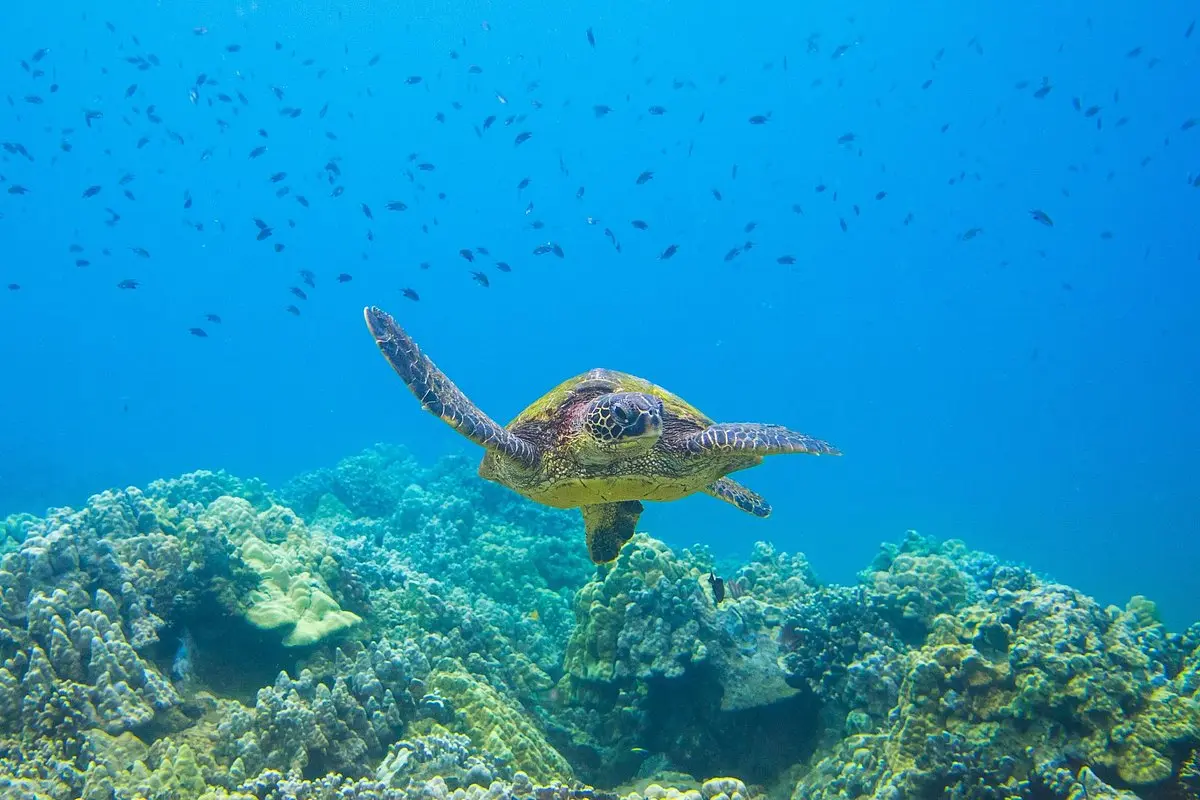
The turtle most visitors see at Turtle Town is the Hawaiian green sea turtle, known as honu. Green turtles use South Maui's coastal reef habitat to feed, rest, travel, and surface for air. Hawksbill turtles, or honuʻea, also occur in Hawaii but are much rarer.
Turtle Town is not an enclosure, sanctuary with fixed boundaries, or guaranteed wildlife stop. It is an informal name for reef habitat along the Makena coast. Turtles decide where to be, and a responsible visit allows them to continue their natural behavior without being followed or surrounded.
Identify Maui sea turtles · Follow the viewing rules
Quick answer: Stay at least 10 feet, or 3 meters, away from sea turtles on land and in the water. Never touch, chase, feed, ride, surround, or block them. Back away when a turtle approaches and use camera zoom instead of closing the distance.
Sea turtle species in Hawaii
Five of the world's seven sea turtle species occur in Hawaiian waters:
- Green sea turtle, or honu
- Hawksbill sea turtle, or honuʻea
- Leatherback sea turtle
- Loggerhead sea turtle
- Olive ridley sea turtle
The green turtle is by far the species most commonly encountered on Hawaii's reefs and beaches. Hawksbills are the second most commonly recorded species but remain rare. Leatherbacks, loggerheads, and olive ridleys are more likely to occur offshore and are rarely seen by a Turtle Town snorkeler.
All sea turtles in Hawaii are protected by federal and state law.
Green turtle or hawksbill?
| Feature | Green sea turtle, honu | Hawksbill sea turtle, honuʻea |
|---|---|---|
| Likelihood near Turtle Town | Commonly encountered species | Rare |
| Head and mouth | More rounded head and beak | Narrower head with a pronounced hawk-like beak |
| Shell edge | Generally smoother | Often appears more serrated, especially when young |
| Shell pattern | Brown, olive, gray, or mottled | Strong overlapping amber, brown, and dark patterning |
| Typical reef diet | Adults mainly graze algae and seagrass | Often feeds on sponges and reef invertebrates |
| Federal status in Hawaii | Threatened Central North Pacific population | Endangered |
Color alone is not a reliable identification method. Water, depth, algae, age, and light can change how a shell looks. Keep the required space rather than approaching for a closer inspection.
Hawaiian green sea turtles
Green turtles are air-breathing reptiles. They must surface, even when they are resting underwater. A turtle rising toward the surface needs a clear route and should never have to turn around a swimmer, kayak, or camera.
Adult honu can grow much larger than visitors expect. Hawaii DLNR describes green turtles as the largest hard-shelled sea turtle, capable of exceeding 350 pounds and reaching roughly 3 to 4 feet in length. Their size does not make them tame. A sea turtle is a powerful protected wild animal.
The name “green turtle” refers to the greenish color of the body fat, not a bright green shell. Shells may appear brown, olive, gray, or patterned, and algae can change their appearance.
Why turtles use the Turtle Town reef
The Makena coast includes rocky reef, lava formations, sandy patches, algae, and routes between shallow and deeper water. These features can support feeding, resting, and travel by green turtles.
Visitors may observe a turtle:
- Grazing algae on reef or rock
- Resting beneath a ledge or near the bottom
- Swimming between feeding areas
- Rising to breathe
- Remaining near reef fish
- Moving along the shoreline
Do not interpret resting or slow movement as an invitation to approach. A turtle that changes direction, stops feeding, swims away, or repeatedly lifts its head may be responding to people.
Turtle Town is a habitat, not a guarantee
Tour listings often use “Turtle Town” as a convenient destination name. In practice, the label can refer to reef near Maluaka Beach, Makena Landing, offshore lava formations, or a captain's selected South Maui stop.
The name does not mean:
- Turtles are kept in one area
- A particular reef always has turtles
- Every tour uses the same site
- A turtle sighting is included with the ticket
- Visitors may approach wildlife for a photograph
A responsible tour can improve access, instruction, and reef awareness, but it cannot schedule a wild animal.
How close can you get to a sea turtle?
NOAA Fisheries and Hawaii DLNR recommend staying at least 10 feet, or 3 meters, away from sea turtles on land and in the water.
The recommended distance helps visitors avoid behavior that could become harassment under federal or state law. It is a minimum viewing buffer, not a target to hold exactly.
Stay farther away when:
- The turtle is resting or nesting
- Several people are already nearby
- The turtle's path is narrow
- Waves or current could push you closer
- Your fins, camera, or kayak extend toward the animal
- The turtle changes behavior
If a turtle swims toward you, stop, remain calm, and move aside without touching it. Give it an open route to the surface, reef, or shore.
What not to do
- Do not touch, pet, hold, or ride a turtle.
- Do not chase it for a photograph.
- Do not swim directly above a turtle that needs to surface.
- Do not surround it with a group.
- Do not block its path to water or land.
- Do not feed it or place food in the water.
- Do not move a resting turtle, hatchling, egg, or nest marker.
- Do not stand on coral to obtain a better view.
- Do not use a drone in a way that disturbs protected wildlife.
- Do not ask a guide to stage a close encounter.
The rule is simple: change your position, not the turtle's behavior.
Taking turtle photos responsibly
Use a wide view or camera zoom to show the turtle in its habitat. An image does not need a face-to-face pose to be memorable.
For underwater photography:
- Set the camera before approaching the viewing area.
- Stay beside your buddy and within the planned route.
- Keep the turtle's route to the surface open.
- Do not extend a selfie stick toward the animal.
- Avoid sudden kicks or pursuit.
- Take a few images, then move on.
- Never rest on coral while composing the shot.
For turtles resting on a beach, keep the 10-foot minimum distance, stay out of the route between the turtle and ocean, and avoid flash or crowding.
Basking, resting, and breathing
Green turtles in Hawaii may bask on shore. Basking means leaving the water to rest, regulate body temperature, conserve energy, or avoid predators. A motionless turtle on the sand is not automatically stranded.
Underwater, a resting turtle can remain submerged for an extended period before surfacing. Do not hover above it. When the turtle begins to rise, give it the full water column.
Call the wildlife hotline when a turtle appears injured, entangled, stranded in an unusual way, or dead. Do not attempt to push a turtle into the water or remove fishing gear yourself.
Nesting and hatchlings
Sea turtles may nest on Hawaiian beaches. Hawaii DLNR describes the green turtle nesting season as running from late April through late October, with hatchlings typically emerging from August through November. Conditions and nesting locations vary by year.
If you see a nesting turtle, marked nest, or hatchlings:
- Stay at least 10 feet away and follow any larger marked buffer.
- Remain quiet and avoid sudden movement.
- Do not use flash photography or bright lights.
- Do not touch or move hatchlings.
- Keep children and dogs away.
- Do not create tracks, holes, chairs, or obstacles in the route to the ocean.
- Notify the appropriate wildlife responder when requested by posted guidance.
Never publish a precise active nest location in a way that attracts a crowd.
Protection and conservation status
All sea turtles in Hawaii are protected under the U.S. Endangered Species Act and Hawaii state law.
The Central North Pacific green turtle population is federally listed as threatened. Hawaii's hawksbill turtle is federally endangered and much rarer. Different organizations may publish separate global and federal assessments, so the page should identify which status system it is describing rather than presenting one label without context.
Protection covers more than deliberate injury. Touching, feeding, chasing, crowding, or altering normal behavior can place both the animal and visitor at risk.
Threats to sea turtles
Sea turtles face risks from:
- Fishing line, hooks, and net entanglement
- Vessel strikes
- Marine debris and plastic ingestion
- Loss or degradation of nesting beaches
- Artificial light that disorients nesting turtles and hatchlings
- Climate change and rising sand temperatures
- Disease
- Illegal harvest or harassment
- Repeated disturbance at feeding and resting sites
Visitors can help by keeping distance, securing trash, reducing single-use plastics, avoiding wildlife disturbance, and reporting injured or entangled animals.
What turtles eat
Adult green turtles in Hawaii commonly graze algae and other plant material. Their feeding helps shape nearshore reef communities. Juveniles may have a more varied diet.
Hawksbills have a narrower beak suited to feeding within reef crevices and commonly eat sponges and other invertebrates.
Never feed a turtle. Human food can change natural behavior, create crowding, and cause harm.
When are turtles most likely to appear?
There is no guaranteed hour, tide, or season for a Turtle Town sighting. Turtles move according to feeding, rest, weather, water conditions, and other natural factors.
Early morning is often recommended for snorkeling because wind and parking can be more manageable, not because turtles follow a visitor schedule. Choose the time based on safe conditions and group ability.
Where visitors may see turtles
Maluaka Beach
Maluaka is the primary public shore access commonly associated with Turtle Town. Reef near the rocky ends can provide habitat, but the snorkeling route depends on conditions and ability.
Makena Landing
Makena Landing is used by snorkelers, divers, kayakers, paddleboarders, and guided groups. It is an access point within the broader habitat, not a guaranteed turtle location.
Offshore boat and kayak sites
Captains and guides may use a South Maui site selected for conditions, visibility, mooring access, and the group's ability. The location marketed as Turtle Town can differ among operators.
Guided tour or independent viewing?
| Option | Advantage | Responsibility |
|---|---|---|
| Guided shore tour | Equipment help, route choice, instruction, and wildlife education | Follow the guide and disclose swimming limitations |
| Kayak tour | Access to coastal reef with a guide and small-group format | Manage paddling, sun, wind, and water entry |
| Boat tour | Crew support, equipment, and possible multiple sites | Accept itinerary changes and stay inside the crew's boundary |
| Independent shore visit | Flexible timing and no tour schedule | Assess conditions, use required safety equipment, and protect the reef |
A guide can point out wildlife without guaranteeing it. Do not choose a tour solely because a product title uses “turtles guaranteed.” Read what the operator actually promises and never pursue an animal to satisfy a marketing claim.
Reporting an injured turtle or violation
For a sick, injured, entangled, stranded, or dead sea turtle in Hawaii, call the statewide NOAA Marine Wildlife Hotline at 888-256-9840.
Be ready to provide:
- Exact location
- Time observed
- The turtle's condition and behavior
- Visible fishing line, hooks, wounds, or identification marks
- Photos or video taken from a responsible distance
- Your contact information if requested
Do not handle the turtle, remove hooks, cut visible line, or enter dangerous water. Follow the responder's instructions.
NOAA lists 800-853-1964 and Hawaii DLNR lists 808-643-DLNR (3567) for reporting illegal or suspicious protected-wildlife activity. Use 911 for an immediate threat to human life.
FAQ
What kind of turtles live at Turtle Town Maui?
The Hawaiian green sea turtle, or honu, is the species visitors most commonly encounter. Hawksbill turtles occur in Hawaii but are much rarer.
Are turtles guaranteed at Turtle Town?
No. Turtle Town is natural reef habitat, not an enclosure. Wildlife location and behavior cannot be guaranteed.
How close can I swim to a sea turtle in Maui?
Stay at least 10 feet, or 3 meters, away on land and in the water. Use a larger buffer when the turtle is resting, surfacing, crowded, or changing behavior.
Is the 10-foot distance a law?
It is the viewing distance recommended by NOAA Fisheries and Hawaii DLNR. Sea turtles are legally protected, and approaching in a way that disturbs or harasses them can violate federal or state law.
Can I touch a sea turtle if it approaches me?
No. Stop, remain calm, and move aside without touching it. Give the turtle a clear route.
Can I feed a turtle?
No. Feeding can harm the animal and change its natural behavior.
Why do turtles come onto Maui beaches?
Green turtles may come ashore to bask, rest, regulate body temperature, or nest. Give them space and do not push them back into the water.
What should I do if a turtle is injured?
Keep your distance and call the NOAA Marine Wildlife Hotline at 888-256-9840. Do not handle the turtle or remove fishing gear.
What is the difference between honu and honuʻea?
Honu is the Hawaiian name for the green sea turtle. Honuʻea refers to the rarer hawksbill turtle, which has a narrower hawk-like beak and is federally endangered.
What is the best time to see turtles at Turtle Town?
There is no guaranteed hour or season. Plan around safe water conditions rather than trying to predict wildlife.
Watch without changing the encounter
The best turtle experience is one in which the animal continues feeding, resting, swimming, or surfacing as if you were not there. Keep the 10-foot minimum distance, protect the reef, and let the turtle control the moment.
Compare Turtle Town tours · Read snorkeling safety · Plan a shore visit