
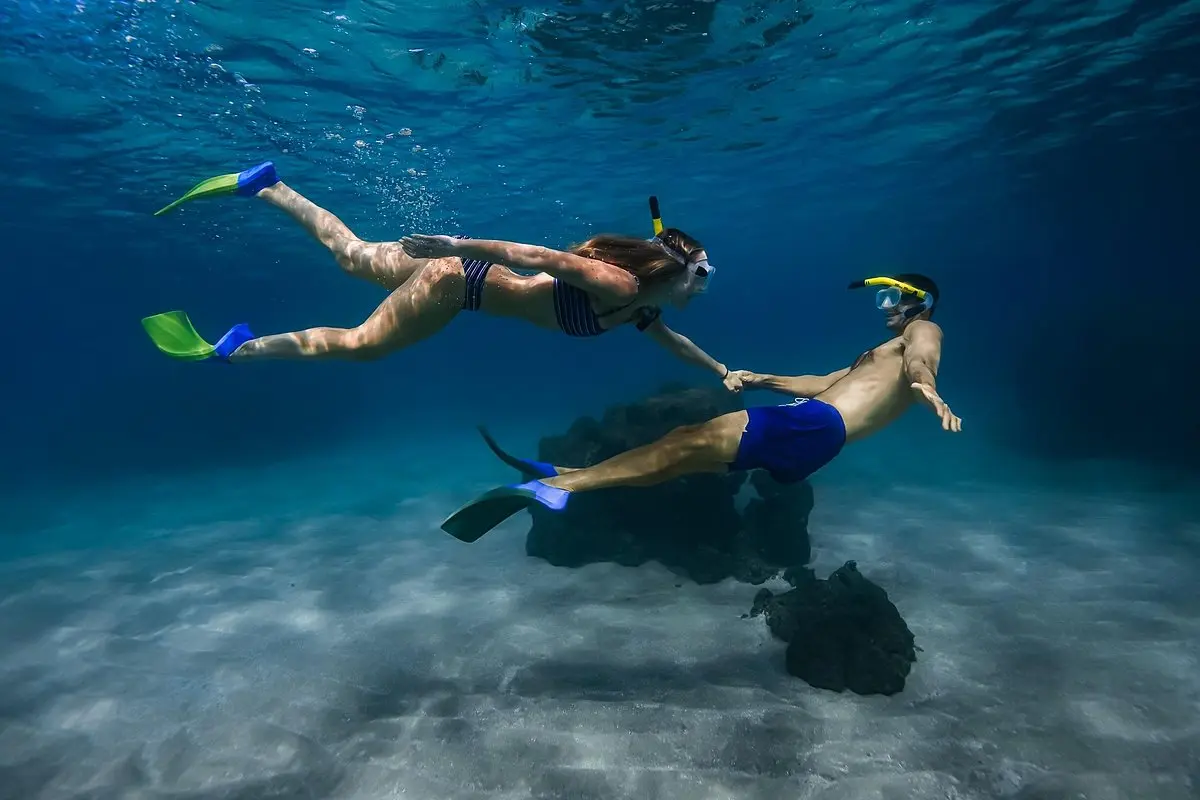
Turtle Town can be reached from shore, but it is not a single marked snorkeling pool with one official entrance. The name generally refers to reef habitat along the South Maui coast near Maluaka Beach and Makena Landing. The right entry depends on conditions, swimming ability, parking, and the type of experience you want.
Maluaka Beach is the primary public beach access for independent snorkeling. Makena Landing is an alternative access and a frequent meeting point for guided snorkel, kayak, paddleboard, and dive tours. Neither location guarantees calm water, easy reef access, or turtle sightings.
Choose an access point · Check the safety requirements
Quick answer: Experienced ocean swimmers can snorkel independently from Maluaka Beach when conditions are suitable. Enter through sand, keep the return point visible, stay within a conservative distance, and explore only as far as your group can comfortably swim back without relying on flotation. Beginners, non-swimmers, families with young children, and visitors unfamiliar with Maui conditions should use a qualified guide.
Can you snorkel Turtle Town without a tour?
Yes. Public shoreline access makes independent snorkeling possible, especially from Maluaka Beach. A tour is not required simply to enter the ocean, and there is no admission gate for a place called Turtle Town.
Independent access does not mean the reef is easy to find or suitable every day. The practical challenges include:
- Choosing the correct public access
- Finding legal parking
- Assessing wind, swell, current, visibility, and shorebreak
- Entering and exiting without stepping on coral or slipping on rock
- Swimming far enough to reach reef while saving energy for the return
- Sharing the area with other swimmers, kayaks, paddleboards, divers, and boats
- Maintaining a safe distance from turtles and other wildlife
If your plan depends on copying other swimmers or following an online map pin into unfamiliar water, use a guided tour instead.
Where to enter
Maluaka Beach
Maluaka Beach is the main shore-snorkeling access associated with Turtle Town. It offers a long sandy beach, public parking, restrooms, showers, and reef near the rocky ends of the shoreline.
The south end is commonly used for reef access because it places swimmers closer to rocky habitat. Enter through a clear sandy route rather than walking over reef or wet rock. The exact route and useful reef area change with tide, visibility, water movement, and ability.
Makena Landing
Makena Landing is a small bay and launch area used heavily by kayaks, paddleboards, divers, and guided tours. It has parking, restrooms, showers, and a grassy area, but its shoreline includes rock and active equipment traffic.
It can be a valid snorkeling access for people who understand the entry and conditions. It is not automatically the easier choice, and the more distant lava features described in dive guides should not become a target for an independent snorkeler.
Maluaka Beach or Makena Landing?
| Factor | Maluaka Beach | Makena Landing |
|---|---|---|
| Main use | Beach day and shore snorkeling | Tour launch, paddling, diving, and shore access |
| Typical entry | Sandy beach, with reef toward rocky ends | Small bay with sandy and rocky sections |
| Facilities | Public parking, restrooms, showers | Public parking, restrooms, showers |
| Activity traffic | Swimmers and beach users | Kayaks, SUPs, divers, guides, and swimmers |
| Best fit | Independent snorkelers who can assess conditions | Guided activities and experienced visitors who know the route |
| Main limitation | Reef may require a meaningful swim | Congestion, rock, and open-water routes beyond the bay |
Choose the location with the safest manageable entry on the day. Do not attempt to swim between the two access points.
Turtle Town is an area, not a pin
Search engines, map platforms, tour operators, divers, and local guides may place the Turtle Town name at different points along the Makena coast. Some use it for reef off Maluaka Beach, some for lava formations nearer Makena Landing, and boat tours may use it for a condition-dependent offshore stop.
No public agency defines a precise visitor boundary. The site's map therefore identifies access points and departure areas without drawing a fixed Turtle Town polygon.
How far is the reef?
There is no single reliable distance because the entry point, tide, route, reef edge, and swimmer's definition of “the reef” vary. Some rocky habitat lies closer to shore, while broader reef exploration can take swimmers farther from the beach.
Do not use a fixed online distance as a target. Before entering:
- Identify the sandy entry and the exact exit point.
- Look for current, wind direction, surface texture, and breaking waves.
- Decide on a maximum distance based on the least capable swimmer.
- Turn around before anyone is tired.
- Keep enough reserve to return without flotation or outside help.
Hawaii's Division of Aquatic Resources advises snorkelers not to go farther than they could swim back without their snorkeling gear. That is a useful standard for every independent visit.
Are you ready to snorkel from shore?
Independent Turtle Town snorkeling is appropriate only when every person can:
- Swim comfortably in open ocean
- Breathe calmly through a snorkel
- Clear or adjust a mask without panic
- Use fins without standing on reef
- Recognize fatigue and turn back early
- Exit through small waves or changing water
- Stay with a buddy
- Follow wildlife-viewing rules
Pool confidence is not the same as ocean competence. Saltwater, waves, depth, visibility, and distance from shore can change how a person responds.
Use a guide if you are:
- A non-swimmer
- A first-time snorkeler
- An anxious ocean swimmer
- Unfamiliar with Hawaii shore entries
- Responsible for young children
- Unsure how to assess conditions
- Managing a medical, mobility, balance, or breathing concern
Compare guided snorkeling tours
Shore entry
The safest entry is normally a clear sandy route with enough depth to float before finning. Avoid stepping onto coral, walking over submerged rock in waves, or putting fins on where they create a fall hazard.
A practical entry sequence
- Watch the shoreline for several minutes before gearing up.
- Identify where swimmers enter and where they return, without assuming their route is right for you.
- Put on the mask and snorkel where footing is stable.
- Carry fins until the water is deep enough to float safely.
- Face the water while moving through small waves.
- Put fins on without standing on coral or losing balance.
- Stay close to your buddy and confirm the exit from the water.
Plan the exit before the swim. Returning through tired legs, glare, changing wind, or small waves can be harder than entering.
Equipment
Mask
A well-fitting mask matters more than an expensive mask. Test the seal before the trip, keep hair and sunscreen away from the skirt, and know how to clear a small leak without standing.
Snorkel
Use a familiar design and practice breathing before swimming away from shore. A dry-top snorkel can reduce splashes but does not prevent all water entry or replace technique.
Fins
Fins improve efficiency and control, especially when wind or current is present. They must fit without painful pressure or looseness. Carry them across sand or stable shallows rather than walking awkwardly over rock.
Flotation
Flotation can improve comfort but may also create false confidence and encourage a weak swimmer to go too far. It is not a substitute for swimming ability, a buddy, or appropriate conditions.
Avoid breath-restricting flotation devices intended to keep the body rigid. Anyone with uncertainty should use an operator-supplied device under direct guide supervision.
Exposure protection
A rash guard or wetsuit top can reduce sun exposure and chill. Use reef-safe sun protection on uncovered skin and apply it before entering so excess product is not immediately washed into the water.
Before entering the water
Use a stop-and-check routine:
- Wind: Is it increasing or pushing surface water away from the return route?
- Swell: Are larger sets reaching the entry or rocky point?
- Current: Are swimmers or floating objects moving steadily in one direction?
- Visibility: Can you see the bottom near the entry?
- Exit: Is the return still clear and uncrowded?
- Traffic: Are kayaks, SUPs, divers, or boats using the path?
- Group: Is the least confident swimmer calm and prepared?
If the answer is uncertain, do not enter. A different beach day is better than testing unfamiliar conditions.
Best time of day
Early morning is normally the better planning window. Parking is easier, heat is lower, and Maui's regular trade-wind pattern often strengthens later.
Morning is not a guarantee. A south or west swell, storm, runoff, local wind, or poor visibility can make early water unsuitable. Check current warnings and judge the actual entry before committing.
See the best time to visit Turtle Town
Weather and visibility
Clear skies do not guarantee clear or calm water. Visibility can fall because of swell, sand movement, rain runoff, algae, plankton, or many swimmers near the entry.
Do not build a trip around an exact visibility number from a general forecast. Conditions can vary within the same coastline and change during the swim.
Leave the water if:
- Wind or chop increases
- The exit becomes difficult to identify
- Visibility drops sharply
- Current moves the group away from the planned route
- Anyone becomes cold, tired, anxious, dizzy, or short of breath
- A swimmer becomes separated from the buddy
- Boat or kayak traffic creates conflict
Buddy system
Every independent swimmer should have a buddy who stays close enough to notice distress. Two people swimming in the same general direction are not necessarily operating as buddies.
Agree before entry on:
- Maximum distance and time
- Turnaround signal
- Lost-buddy procedure
- Hand signals for okay, help, and return
- What to do if one person wants to exit early
Count the group before entering and after exiting.
Children
A child who swims in a pool may not be ready for open-ocean snorkeling. Consider the child's ability to wear a mask, breathe through a snorkel, tolerate saltwater, use fins, follow signals, remain beside an adult, and exit without panic.
For a child's first attempt:
- Use a guided or closely supervised shallow-water practice
- Choose daylight and genuinely mild conditions
- Fit equipment before reaching the beach
- Keep the session short
- Avoid a long swim to reach reef
- Assign one capable adult to each child who needs close support
Do not tow multiple inexperienced children toward offshore reef. A boat tour with shade, restrooms, food, and crew may be a better family choice.
Read the snorkeling with kids guide
Non-swimmers
Independent shore snorkeling is not appropriate for a non-swimmer. A flotation belt or vest does not solve the risks of water entry, mask problems, waves, current, separation, or panic.
Some operators offer guided experiences specifically for first-timers and non-swimmers. Book the exact beginner product, disclose the person's true ability, and ask what flotation, shallow-water practice, and guide ratio are provided.
Find a guided non-swimmer option
Turtles and wildlife
Green sea turtles are frequently associated with South Maui reef, but no independent visit or tour can guarantee a sighting. Search without chasing, keep the group loose, and allow animals to surface, feed, rest, and travel normally.
NOAA and Hawaii agencies recommend staying at least 10 feet, or 3 meters, from sea turtles on land and in the water.
- Do not touch, feed, ride, chase, surround, or block a turtle.
- Never hold coral, rock, or a turtle for a photograph.
- Do not swim over a turtle that is trying to surface.
- If an animal approaches, remain calm and create space where possible.
- Use camera zoom instead of moving closer.
Protecting the reef
- Enter through sand rather than coral.
- Keep fins and knees above the reef.
- Never stand on coral to rest or adjust equipment.
- Do not collect shells, coral, rock, or marine life.
- Secure cameras and straps so they do not drag.
- Take all trash and fishing line away from the beach.
- Do not feed fish or other wildlife.
If you need to stand, return to a known sandy area. Dark underwater surfaces are not necessarily safe rock.
Guided tour or independent visit?
| Choose a guided tour if | Choose independent snorkeling if |
|---|---|
| You are new to ocean snorkeling | You are a confident open-ocean swimmer |
| You need flotation or instruction | You can assess wind, swell, current, and entry |
| You want a guide to choose the route | You accept turning back without reaching a named site |
| You are visiting with young children | Every participant can manage the full swim and exit |
| You want photos without carrying a camera | You have reliable, familiar equipment |
| You do not know the access points | You understand the public access and parking rules |
A guide does not guarantee wildlife or perfect water, but good instruction and conservative route selection can reduce avoidable mistakes.
Shore alternatives
If shore conditions are unsuitable, do not assume a boat or kayak tour will operate. The same wind or swell may affect all ocean activities.
When operators approve conditions, alternatives include:
- Guided Turtle Town snorkeling
- Makena kayak and snorkel tours
- Private Turtle Town tours
- Molokini and Turtle Town boat tours
Book the format that fits the weakest participant, not only the person most excited to enter the water.
What to bring
- Correctly fitted mask, snorkel, and fins
- Appropriate flotation when needed
- Rash guard or wetsuit top
- Reef-safe sun protection
- Drinking water
- Towel and dry clothes
- Secure footwear for the shore approach
- Required medication
- Waterproof phone protection only if it will not distract from safety
- Minimal valuables
Do not leave keys, phones, passports, or bags visible in the vehicle.
FAQ
Can you snorkel Turtle Town from shore?
Yes. Maluaka Beach is the primary public shore access associated with Turtle Town, while Makena Landing is an alternative and a common guided-tour launch.
Do I need a tour?
No tour is legally required for public shore access. A guide is strongly recommended for beginners, non-swimmers, children, and visitors who cannot independently assess the conditions and route.
Is Turtle Town one exact snorkeling spot?
No. The name is used for a broader South Maui reef area near Maluaka Beach, Makena Landing, and offshore tour sites. There is no officially defined visitor boundary.
Which beach is best for shore snorkeling?
Maluaka Beach is the primary independent access. The best choice still depends on the day's water, parking, entry, and the group's ability.
How far do I need to swim?
There is no reliable universal distance. The reef, entry, and route vary. Never swim farther than you can comfortably return without relying on flotation or your snorkel equipment.
Is shore snorkeling free?
Public beach access does not require a Turtle Town admission ticket. Parking rules and tour or equipment costs are separate and can change.
What time is best?
Early morning is normally the most practical window because wind often increases later. Always check actual conditions and current warnings.
Is it safe for non-swimmers?
Independent shore snorkeling is not appropriate for non-swimmers. Use a beginner-specific guided experience and disclose the person's exact ability before booking.
Are turtles guaranteed?
No. Turtles are wild animals. Give any turtle at least 10 feet of space and never chase, touch, feed, surround, or block it.
Is there a lifeguard?
Do not plan an independent visit around lifeguard coverage at these access points. Check current signage and use a qualified guide if you cannot assess and manage the ocean yourself.
Plan a shore-snorkeling visit
Choose Maluaka Beach for the primary shore access or Makena Landing when its entry and shared launch environment fit your experience. Arrive early, inspect the water, stay with a buddy, keep the return conservative, and leave the reef and wildlife undisturbed.
Read the Maluaka Beach guide · Open the Turtle Town map · Read the snorkeling safety guide