
Turtle Town is open ocean. Maluaka Beach, Makena Landing, kayak routes, and boat stops can look calm while still having current, waves, wind, poor visibility, boat traffic, and changing exits. Safe snorkeling begins with the decision to stay out when the conditions or your ability are not a good match.
Hawaii's Department of Health reports that snorkeling has been a leading activity associated with ocean drownings, especially among non-residents. Treat it as a physical water activity, not passive sightseeing. A mask, fins, vest, guide, or nearby beach does not eliminate drowning risk.
Use the pre-entry check · Know when to stay out
Quick answer: Snorkel with a capable buddy, watch several wave sets before entering, use equipment you can clear and control, stay close enough to swim back without fins, and keep the exit in sight. Do not enter when the water is rough, murky, fast-moving, crowded with vessels, or beyond the weakest swimmer's ability.
When not to snorkel
Stay out of the water when any one of these is true:
- An official closure or high-surf, strong-wind, storm, flash-flood, sewage, or brown-water warning affects the area
- Waves make the sandy entry or exit difficult
- Water is moving quickly along or away from shore
- Visibility is too poor to monitor your buddy, reef, bottom, or exit
- Wind or current is pushing floating objects away from the return point
- The only entry requires crossing wet rock, coral, or breaking waves
- You are alone
- You cannot swim comfortably without depending on a flotation device
- You are ill, unusually tired, short of breath, dizzy, anxious, impaired, or recovering from travel in a way that affects exertion
- You cannot get a comfortable seal and breathe calmly through the equipment
- The weakest swimmer does not want to enter
- A lifeguard, guide, captain, official sign, or local authority says not to enter
There is no penalty for changing the plan. The safer choice may be a guided tour, a beach visit without snorkeling, another day, or another activity.
The five-minute pre-entry check
1. Check official information
Review Hawaii Safe Beach Day, National Weather Service surf and marine forecasts, and Hawaii Department of Health water-quality advisories. Confirm that the beach, road, and parking area are open.
Official information is the starting point. A broad zone forecast cannot certify one entry as safe.
2. Watch the water
Hawaii DLNR advises watching waves for about 15 minutes because waves arrive in sets. Observe long enough to see the larger sets, not only a calm pause.
Look for:
- Where waves break
- Whether water moves parallel to shore
- Whether foam, leaves, or swimmers drift seaward
- How people are entering and exiting
- Boat, kayak, and paddleboard traffic
- A sandy route that stays usable
3. Identify the exit
Choose the return point before entering. Note fixed landmarks that remain visible from the water. Ask how the route changes if wind or current increases.
Do not plan to climb onto reef, coral, or slippery rock if the sandy exit becomes difficult.
4. Check the group
The plan must fit the least experienced swimmer. Confirm that every person can:
- Swim in open water without depending on a vest
- Breathe through the snorkel without panic
- Clear water from the mask and snorkel
- Float or rest while communicating
- Turn back immediately when asked
- Reach the entry without exhaustion
5. Check the equipment
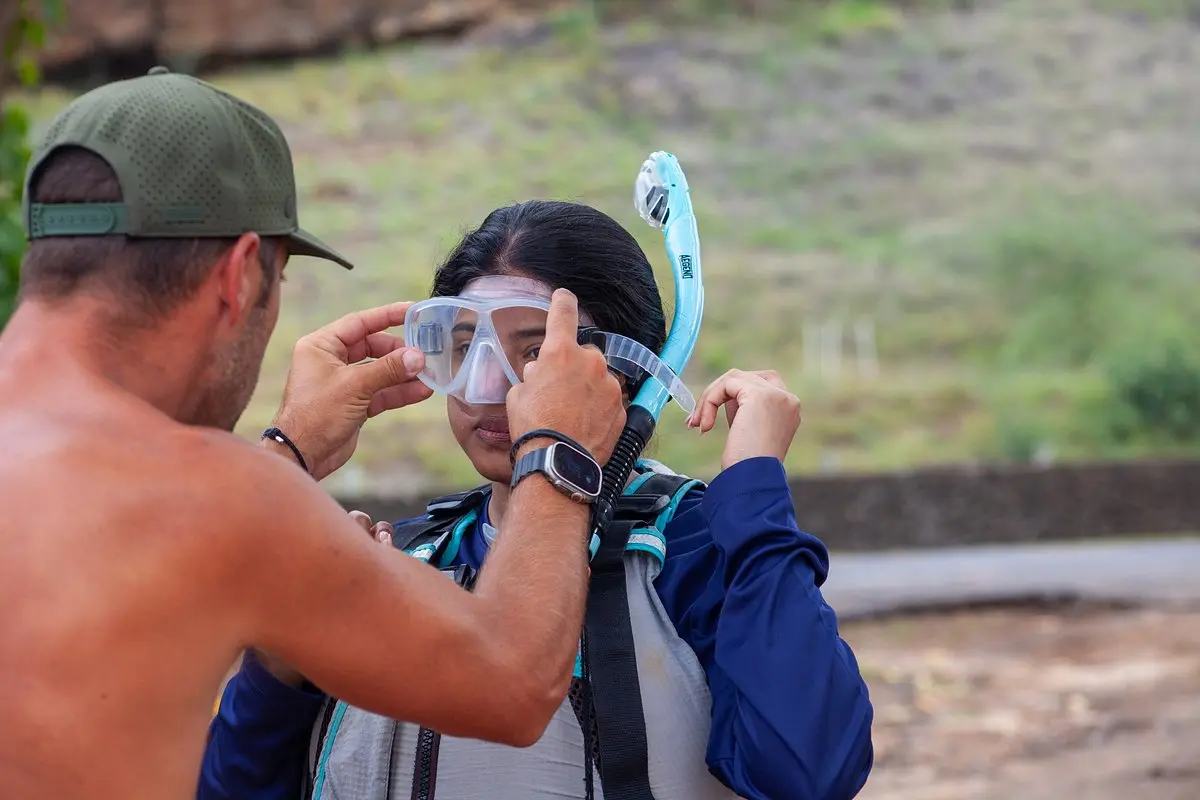
Fit the mask, snorkel, fins, and flotation before entering. Replace anything that leaks, pinches, slips, restricts breathing, or cannot be adjusted quickly.
If any part of the check fails, do not enter.
Snorkel with a capable buddy
A buddy is an active safety partner, not another person somewhere on the beach. Stay close enough to see each other's face, communicate, and help without a long swim.
Before entering, agree on:
- The route and maximum distance
- A clear turnaround point
- Hand signals for okay, stop, help, and return
- Who carries the surface marker or flag
- What to do if separated
- Who calls emergency services
If separated, stop the activity, look briefly from a stable position, and return to the agreed exit or seek help. Do not continue the sightseeing route.
Children need direct, continuous adult supervision in the water and on shore. A child should not be assigned as an adult's safety buddy.
Stay within your return ability
Hawaii DLNR advises snorkelers not to go farther than they could swim back without snorkeling gear. This is a useful test because fins can break or come off, a mask can flood, and a snorkel can become unusable.
Turn around before you feel tired. The outward leg may be assisted by wind or current, leaving a harder return. Keep enough reserve to manage waves at the exit, remove fins if necessary, and help your buddy.
Signs to end the snorkel include:
- Faster or strained breathing
- Repeated mask or snorkel problems
- Leg cramps
- Shivering or feeling unusually cold
- Anxiety, confusion, or loss of coordination
- Drifting away from the exit
- Rising wind or waves
- Reduced visibility
Do not wait for the group to become exhausted together.
Entry and exit
Choose sand
Enter and exit through a sandy area when possible. Avoid standing on coral, stepping into holes, or crossing rock washed by waves. Wet rock and algae can be extremely slippery.
Put fins on at the right point
Follow the guide's instructions or use a stable shallow position where you can maintain balance without standing on reef. Walking long distances in fins increases fall risk.
Keep the airway clear
Enter only after breathing is calm. If a wave hits, equipment floods, or you become disoriented, roll or stand only where it is safe, remove the mouthpiece, establish normal breathing, and signal your buddy.
Plan the return
Approach the sandy exit with energy in reserve. Watch behind you for waves, keep space from other people, and remove fins only when you can do so without losing balance or being pushed onto reef.
Equipment
Mask
The mask should seal without excessive strap pressure. Hair, sunscreen, facial hair, or a folded skirt can break the seal. Practice clearing a small amount of water in calm, controlled conditions before starting the route.
Snorkel
Use a snorkel you understand and can clear. Breathe normally. Do not extend the tube, modify the equipment, or continue if breathing feels restricted.
Fins
Fins should fit securely without causing pain. They improve propulsion but do not replace swimming ability. Keep kicks controlled near other people and above fragile reef.
Flotation
A properly fitted vest or belt can support a comfortable swimmer, but it does not prevent panic, mask flooding, separation, current, or exhaustion. Non-swimmers should not treat flotation as permission for independent open-ocean snorkeling.
Know whether the device is designed to keep an unconscious person's airway clear. Many snorkeling aids are not life jackets.
Exposure and sun protection
A rash guard or suitable exposure layer reduces sun and abrasion exposure. Use shade, hydration, and sunscreen that complies with Hawaii requirements. Apply products before entering so they are less likely to wash directly into the water.
Diver-down flag
Hawaii DLNR states that snorkeling, free diving, and scuba diving require a red-and-white diver's flag while the activity is in progress. In ocean waters, participants must surface within 100 feet of the flag. Do not swim in navigation channels, and do not display the flag when no underwater activity is taking place.
On a guided tour, ask how the operator handles the required surface marker. Independent snorkelers are responsible for understanding and following the current rule.
Wind, waves, current, and visibility
Wind
Wind can create chop, push swimmers and kayaks, make breathing less comfortable, and hide calls for help. Check whether the forecast expects wind to increase during the activity.
Waves
Waves come in sets. Watch from shore long enough to see the larger ones. Do not enter through breaking surf simply because the period between sets looks calm.
Current
Current may run along the beach or away from shore. If caught in a rip current, remain calm and avoid exhausting yourself by swimming directly against it. Move parallel to shore to leave the narrow flow, then angle toward a safe exit and signal for help.
Visibility
Poor visibility makes it harder to monitor the reef, depth, buddy, vessels, and return route. Do not swim farther out in search of clear water.
Rapid change
Continue checking conditions while in the water. The decision to enter is not permanent. Return early when the water changes.
Health and readiness
Snorkeling requires breathing through equipment while floating face-down and swimming in open water. Do not participate when illness, medication, alcohol, cannabis, fatigue, dehydration, or a health condition could impair breathing, alertness, balance, or exertion.
Before a tour, disclose relevant medical conditions and mobility needs honestly. Review the operator's restrictions and ask a qualified clinician about participation when you have concerns related to heart or lung disease, fainting, seizure, recent surgery, pregnancy, or exercise tolerance.
Do not use a successful pool swim or a past vacation as proof that today's ocean is appropriate. Travel fatigue, recent illness, and unfamiliar equipment can change performance.
Stop immediately if you develop chest discomfort, severe shortness of breath, faintness, confusion, unusual weakness, or a feeling that something is wrong. Signal for help and leave the water.
Beginners and non-swimmers
A beginner who can swim may benefit from a guide, a short sandy entry, calm water, close supervision, and time to practice equipment skills before moving away from shore.
A non-swimmer should not independently snorkel at Turtle Town. Flotation can keep someone near the surface but cannot provide judgment, propulsion, airway control, or a safe response to waves and panic.
Choose a guided activity that explicitly accepts the person's ability level, then confirm:
- Guide-to-guest ratio
- In-water support
- Type of flotation
- Entry depth and surface
- Swimming requirement
- Medical restrictions
- Whether the guest may remain on shore or aboard if conditions change
An operator's acceptance does not require a guest to enter.
Compare guided snorkeling tours
Children and families
Use the child's actual open-water ability, not only age or confidence in a pool. A child should be able to follow instructions, tolerate a mask, breathe calmly, and stay close to a designated adult.
Family rules:
- Assign one attentive adult to each child or small number of capable children
- Keep the route short and close to the exit
- Use correctly fitted equipment designed for the child
- Do not force mask or snorkel use
- Stop before the child becomes cold or tired
- Keep children away from coral, rocks, and moving water at the shoreline
- Confirm the tour's minimum age, swimming, and adult-accompaniment rules
If supervision would divide the adults' attention, take turns snorkeling.
Read the snorkeling-with-kids guide
Boats, kayaks, and paddleboards
Turtle Town access areas are shared. Snorkelers can be difficult to see from a vessel, especially in chop.
- Stay out of navigation channels and active launch paths.
- Use the required diver-down flag.
- Remain aware of engine sound, paddles, boards, and guide signals.
- Do not assume a boat operator can see a dark snorkel or a head at water level.
- Avoid swimming between a kayak group and its guide.
- Give vessels space to maneuver near ramps and shoreline loading areas.
- Surface carefully and look around before lifting your head or changing direction.
From a tour boat, follow the crew's entry, exit, buddy, recall, and boundary instructions. Do not leave the marked group area to follow wildlife.
Reef and wildlife safety
Protect the reef
Coral is living and easily damaged. It can also cause cuts that become infected.
- Stand only on sand where standing is necessary and safe.
- Do not touch, sit on, kick, or rest on coral.
- Keep fins above the reef.
- Do not reach into holes or crevices.
- Leave shells, rocks, and marine life in place.
Give turtles space
NOAA Fisheries and Hawaii DLNR recommend remaining at least 10 feet, or 3 meters, from sea turtles on land and in the water.
- Never touch, chase, feed, ride, or surround a turtle.
- Do not block its path to the surface or shore.
- Back away if the turtle approaches.
- Use camera zoom instead of moving closer.
- Keep the encounter brief and passive.
Other protected animals have different viewing distances. Stay at least 50 feet from Hawaiian monk seals, with greater distance around mothers and pups, and obey signs or barriers. Do not approach or remain close to dolphins or whales while swimming.
Water quality and weather
After storms, runoff can carry sewage, harmful microorganisms, and pollutants into the ocean. Hawaii's Department of Health advises staying out of beaches and streams contaminated by brown water and avoiding water affected by sewage or chemical spills.
Do not enter when:
- A brown-water, sewage, or chemical-spill advisory is active
- Water is unusually brown or contains runoff debris
- A stream is discharging visibly into the swimming area
- Heavy rain, thunder, or lightning affects the coast
- Officials have not cleared a recently affected area
Wait for current Department of Health instructions rather than applying a fixed number of hours to every event.
If something goes wrong
If you are in trouble
- Signal your buddy, guide, crew, or people on shore immediately.
- Establish flotation and normal breathing.
- Remove the snorkel from your mouth if it interferes with breathing.
- Avoid fighting current directly until exhausted.
- Move toward the safest reachable exit or await trained help.
- Call or direct someone to call 911 for an emergency.
If another person is in trouble
Call for trained rescue help and 911. Throw or extend flotation when possible. Do not make an untrained in-water rescue that creates a second victim. Follow instructions from lifeguards, guides, crew, or emergency dispatch.
Once the person is out, begin CPR and use an AED if needed and if you are trained, while another person directs responders to the exact access point.
If a person is missing
Call 911 immediately. Provide the last known location, time, clothing or equipment colors, direction of travel, and the planned exit. Do not delay the call while conducting a prolonged personal search.
Injured or stranded wildlife
Do not handle the animal. In Hawaii, report a sick, injured, stranded, or dead sea turtle or marine mammal to the NOAA Marine Wildlife Hotline at 888-256-9840.
Location-specific reminders
Maluaka Beach
- Use a sandy entry rather than crossing reef or slippery rock.
- Keep the north and south public access arrangements separate.
- Do not assume the rocky south end is suitable because other people are present.
- Keep enough reserve for the return along the beach.
Makena Landing
- Watch for kayaks, paddleboards, divers, and commercial groups.
- Do not use the protected-looking bay as proof that the route beyond it is calm.
- Avoid navigation and launch paths.
- Use a guide when you do not understand the entry, exit, or offshore route.
Boat tours
- Listen to the complete safety briefing.
- Tell the crew about medical concerns and swimming limitations before entering.
- Stay inside the crew's marked area.
- Return at the first recall signal.
- Use the vessel's ladder and handholds as instructed.
- Accept itinerary changes made for safety.
FAQ
Is Turtle Town safe for snorkeling?
It can be appropriate for capable snorkelers or guided guests in suitable conditions. It is still open ocean, and safety depends on the exact entry, current conditions, equipment, health, and swimming ability.
Is Maluaka Beach safe for beginners?
The sandy beach can make access more practical, but the reef route is not automatically beginner-safe. Choose calm conditions, a short route, and a guide when skills or judgment are limited.
Can a non-swimmer snorkel at Turtle Town?
A non-swimmer should not snorkel independently in the open ocean. Ask a qualified operator whether it offers an experience designed for that ability level, and do not enter if the person is uncomfortable.
Do I need a buddy?
Yes. Hawaii DLNR recommends swimming, snorkeling, and diving with a partner. Stay close enough to monitor and assist each other.
Do snorkelers need a dive flag in Hawaii?
Hawaii DLNR states that snorkeling requires a red-and-white diver's flag while the activity is in progress. In ocean waters, snorkelers must surface within 100 feet of it. Check the current rule and ask a guide how the tour complies.
How far should I swim from shore?
Do not go farther than you could swim back without your snorkeling gear. Use a shorter limit when wind, current, waves, fitness, or the weakest buddy requires it.
What should I do in a rip current?
Remain calm, avoid exhausting yourself by swimming directly against it, and move parallel to shore until free of the narrow current. Signal for help and then angle toward a safe exit.
Is a snorkel vest a life jacket?
Not necessarily. Many snorkeling aids are designed for surface support and may not keep an unconscious person's airway clear. Check the device label and do not use flotation as a substitute for swimming ability.
Is it safe to snorkel after rain?
Do not enter water affected by brown-water, sewage, or chemical-spill advisories. Runoff can reduce visibility and carry harmful pollutants. Follow current Hawaii Department of Health guidance.
How close can I get to a turtle?
Stay at least 10 feet, or 3 meters, away on land and in the water. Never touch, chase, feed, surround, or block a turtle.
Make the conservative decision
A successful Turtle Town visit ends with everyone back on shore or aboard with energy to spare. Keep the route short, stay with your buddy, protect the reef, and leave the water as soon as conditions or comfort decline.
Check the best time to visit · Plan shore snorkeling · Compare guided tours